GEOTECHNICAL ENGINEERING1
CHRISTCHURCH
HomeLaboratoryGrain size analysis (sieve + hydrometer)

Grain size analysis (sieve + hydrometer) in Christchurch

Sound ground. Sound decisions.

LEARN MORE

Christchurch still lives with the memory of the 2010-2011 Canterbury earthquake sequence, a period that reshaped the city’s relationship with its own ground. Much of the urban area sits on alluvial plains where silts and fine sands dominate the subsurface, making particle size distribution more than a routine index test. For developers and geotechnical engineers, a reliable grain size analysis (sieve + hydrometer) determines how water moves through the soil, how the ground might behave under cyclic loading, and whether a fill material meets compaction specifications. At our ISO 17025-accredited laboratory, we process hundreds of Christchurch samples each year, from Riccarton gravels to the silty fines of the eastern suburbs. A complete gradation curve, covering the full range from coarse sand down to the clay fraction, often pairs with liquefaction screening when the water table is high and the fines content becomes critical.

A 5% error in fines content can flip a Christchurch soil from 'non-liquefiable' to 'liquefiable' — the hydrometer step is not optional here.
Our service areas

Methodology and scope

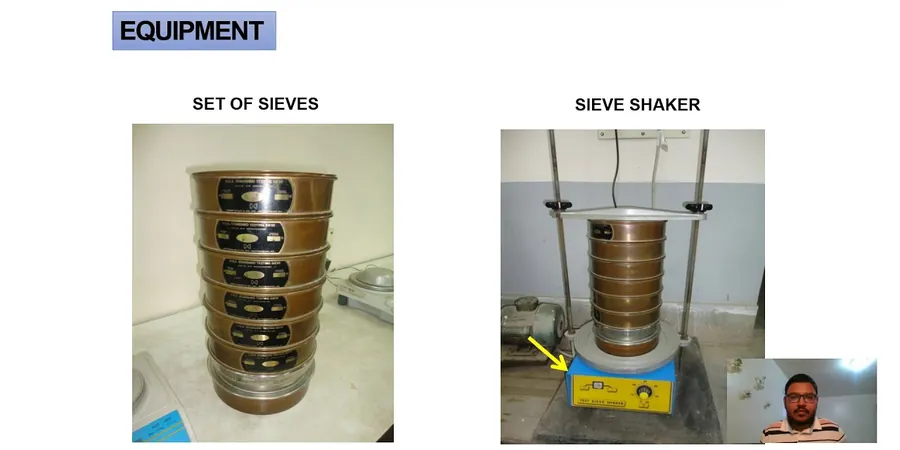
In Christchurch, we frequently see site investigation reports where the field description says 'sandy silt' but the lab gradation reveals 15% clay passing the 2-micron mark — that difference changes the entire liquefaction classification. Our analysis covers the full spectrum: dry sieving for the coarse fraction retained on the 75-micron sieve, followed by hydrometer sedimentation for the fines, conforming to NZS 4402 Test 6.2 and 6.5. We wash every sample through the 75-micron sieve before dry sieving, because skipping that step in silty soils overestimates the sand fraction and leads to overly optimistic drainage assumptions. The hydrometer phase uses sodium hexametaphosphate dispersion and temperature-controlled baths, with readings logged at the standard time intervals. What the client receives is not just a table of percentages — it is a plotted gradation curve with D10, D30, D50, D60, coefficients of uniformity and curvature, and a clear statement of the fines content that directly feeds into the NZGS soil classification.
Grain size analysis (sieve + hydrometer) in Christchurch
Technical reference — Christchurch

Local considerations

The contrast between Riccarton and the eastern suburbs around New Brighton tells the Christchurch story in gradation curves. In Riccarton, we often see well-graded gravels with less than 5% fines — competent material that drains freely and compacts to high density. Shift east toward the Avon River corridor, and the same depth horizon can yield 40% fines with a plasticity index that puts the soil squarely in the problematic category. That shift has direct consequences: a foundation designed for Riccarton gravels becomes a settlement risk if the underlying material is actually a silty clay with slow pore pressure dissipation. Particle size distribution also controls the selection of filter materials for retaining walls and subsurface drains. A poorly graded fine sand from the coastal fringe will pipe right through a standard drainage aggregate unless the filter gradation is checked against Terzaghi's criteria. The cost of skipping this analysis is measured in cracked slabs, blocked drains, and liquefaction-induced settlements that could have been predicted from the grain size curve alone.

Need a geotechnical assessment?

Reply within 24h.

Email: contact@geotechnical-engineering1.co

Explanatory video

Applicable standards

NZS 4402:1986 Test 6.2 (sieve analysis), NZS 4402:1986 Test 6.5 (hydrometer analysis), NZGS Guideline: Soil and Rock Description in the Field

Technical parameters

ParameterTypical value
Sieve range75 mm to 75 µm (coarse to fine sand)
Hydrometer range75 µm to sub-2 µm (silt and clay fraction)
Test standardNZS 4402:1986 Test 6.2 / 6.5
Dispersion methodSodium hexametaphosphate, mechanical stirrer
Sample mass (coarse)500 g to 5 kg depending on max particle size
Sample mass (hydrometer)50 g of minus 75 µm material
Reporting parametersD10, D30, D50, D60, Cu, Cc, % gravel, % sand, % silt, % clay
Typical turnaround3–5 working days (Christchurch lab)

Frequently asked questions

How much does a particle size analysis cost in Christchurch?

A standard sieve analysis runs from NZ$200 to NZ$280, while the combined sieve plus hydrometer method ranges from NZ$280 to NZ$360, depending on sample condition and whether the material requires extended dispersion time.

Why is the hydrometer analysis important for Christchurch soils?

Many Christchurch soils contain a significant silt and clay fraction that cannot be quantified by sieving alone. The hydrometer measures the particle size distribution below 75 microns, which directly affects the soil's drainage behaviour, liquefaction susceptibility under seismic loading, and its classification under the NZGS system. Without this step, fines content is only an estimate, and that uncertainty can lead to conservative — or dangerously optimistic — design assumptions.

How long does a combined sieve and hydrometer test take?

We quote 3 to 5 working days for a combined analysis. The hydrometer phase alone requires at least 24 hours of sedimentation readings, and the full procedure includes oven-drying, washing through the 75-micron sieve, dry sieving the coarse fraction, and then the hydrometer run with readings at 0.5, 1, 2, 4, 15, 30, 60, 120, 240, and 1440 minutes.

Location and service area

We serve projects across Christchurch and its metropolitan area.

View larger map