GEOTECHNICAL ENGINEERING1
CHRISTCHURCH
HomeGround improvementStone column design

Stone Column Design for Christchurch’s Vulnerable Ground

Sound ground. Sound decisions.

LEARN MORE

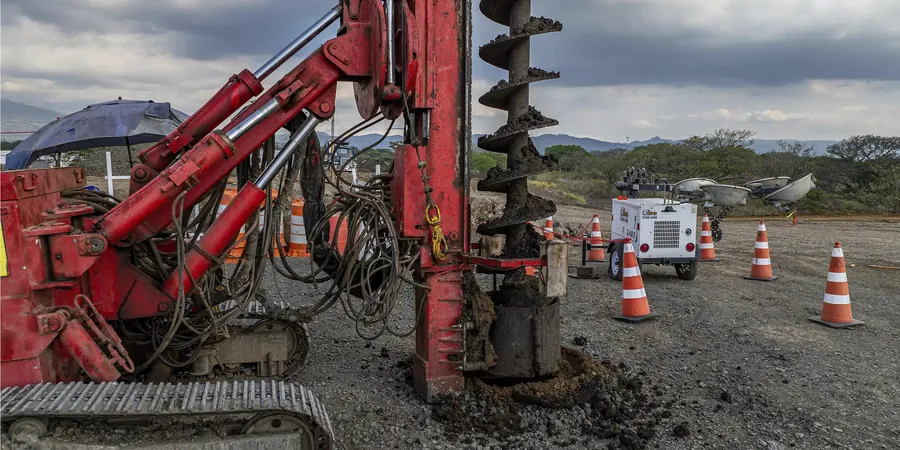
The vibrator probe hangs from the rig’s leader, a steel lance ready to punch through Christchurch’s layered silts and sands left by the Waimakariri’s historic shifts. Stone column design here isn’t a generic exercise—it starts with knowing where the groundwater table sits in a given month, how the fluvial gravels thin out toward the eastern suburbs, and what the February 2011 event revealed about cyclic softening at each depth. We feed site-specific CPT data into the Priebe method, adjusting for radial confinement and the modular stiffness ratio that governs load transfer between the column and the surrounding matrix. In practice, that means designing a grid that won’t just densify the ground but will drain excess pore pressure fast enough to keep the soil skeleton intact during the next big shake. A well-calibrated CPT test provides the continuous stratigraphic profile needed to set the column length, while liquefaction analysis defines the target improvement ratio for volumetric strain control.

Stone columns in Christchurch must perform double duty: stiffen the ground and bleed off pore pressure before it triggers liquefaction.

Our service areas

Methodology and scope

What we often see across Christchurch—especially in zones that underwent severe lateral spreading during the Canterbury sequence—is that the native sandy silts lose stiffness abruptly once the cyclic stress ratio passes about 0.25. The stone column design compensates by creating a composite ground mass where the columns act as vertical drains, shortening the drainage path from metres to centimetres. A typical installation uses bottom-feed vibro-replacement with 800 to 1200 mm diameter columns on a triangular spacing of 1.8 to 2.5 m, though tighter grids are warranted near bridge abutments where differential settlement can’t exceed 25 mm. We verify the improvement with post-installation CPT soundings and plate load tests, comparing the measured settlement against the predicted performance from the Priebe or Balaam-Booker solution. The material specification for the stone fill is equally strict: clean, angular, hard-wearing aggregate with less than 5% passing the 75 µm sieve, because fines migration clogs the drainage function and undermines the whole concept.
Stone Column Design for Christchurch’s Vulnerable Ground
Technical reference — Christchurch

Local considerations

The post-earthquake rebuild pushed development into Christchurch’s Technical Category 2 and 3 land, where the subsurface profile reads like a cautionary tale: loose to medium-dense sands over soft cohesive layers, with the groundwater table hovering barely a metre below the surface in winter. The urban creep eastward since the 1960s placed subdivisions over old swamp deposits that hadn’t been properly characterised until the Canterbury Geotechnical Database collated the damage evidence. Stone column design in these conditions can’t rely on textbook assumptions. If the vibro-replacement doesn’t fully penetrate a buried peat lens or if the column terminates prematurely in a soft clay band, the composite ground can still suffer excessive settlement under the design bearing pressure. We map these weak layers with high-resolution CPT and sometimes cross-check with a seismic refraction survey to ensure the columns bear onto competent gravels or at least reach a depth where the confining stress is sufficient to limit lateral bulging.

Need a geotechnical assessment?

Reply within 24h.

Email: contact@geotechnical-engineering1.co

Applicable standards

NZS 3404:1997 Steel Structures (rig components and casing), NZS 4404:2010 Land Development and Subdivision Infrastructure, NZGS Guideline: Ground Improvement for Liquefaction Mitigation, ASTM D5879 Standard Practice for Design of Ground Improvement Using Stone Columns, Canterbury Geotechnical Database – Liquefaction Vulnerability Parameters

Technical parameters

ParameterTypical value
Design methodPriebe (1995) with modular ratio adjustment
Column diameter range0.8–1.2 m (bottom-feed vibro-replacement)
Typical grid spacing1.8–2.5 m triangular pattern
Aggregate specificationAngular crushed rock, <5% fines (75 µm)
Area replacement ratio (as)10–35% depending on performance target
Post-treatment verificationCPT soundings + plate load test (NZS 4404)
Settlement reduction factor (n)2.0–4.0 typical for Christchurch silts
Drainage functionRadial consolidation coefficient ch ≥ 2 m²/yr target

Frequently asked questions

What’s the cost range for stone column design and installation in Christchurch?

For a typical residential or light commercial lot in Christchurch, stone column design and installation generally falls between NZ$2.820 and NZ$8.120, depending on the treatment depth, column diameter, grid density, and access constraints. A detailed site investigation is always required to fix the scope accurately.

How do Christchurch’s soil conditions affect stone column performance?

The interbedded sands, silts, and occasional peat lenses found across the city demand a careful evaluation of where the columns terminate. We use CPT data to identify any soft seams that could undercut the improvement, and we design the columns to either penetrate through those layers or densify them sufficiently to meet settlement criteria.

Which design method is used for stone columns in New Zealand?

The Priebe method is the most common framework, but we adapt it to local conditions by calibrating the modular ratio against Christchurch-specific back-analysis from post-earthquake case histories. The Balaam-Booker approach is sometimes used when the column group effect and radial consolidation need a more rigorous coupled analysis.

How is the effectiveness of stone columns verified after installation?

We run post-installation CPT soundings through the centre of the column grid and between columns, comparing tip resistance and sleeve friction to pre-treatment baselines. Plate load tests on single columns and column groups confirm the stiffness improvement, following the testing procedures outlined in NZS 4404.

Can stone columns replace deep foundations in Christchurch’s TC3 land?

In many TC3 sites, a well-designed stone column grid can reduce liquefaction-induced settlement enough to support a stiffened slab-on-grade, avoiding the need for driven piles. However, if the site has a continuous soft clay layer thicker than about 3 m near the surface, or if the required bearing pressure is high, a piled solution may still be more appropriate.

Location and service area

We serve projects across Christchurch and its metropolitan area.

View larger map