GEOTECHNICAL ENGINEERING1
CHRISTCHURCH
HomeSeismicSeismic microzonation

Seismic Microzonation in Christchurch: Site-Specific Ground Response

Sound ground. Sound decisions.

LEARN MORE

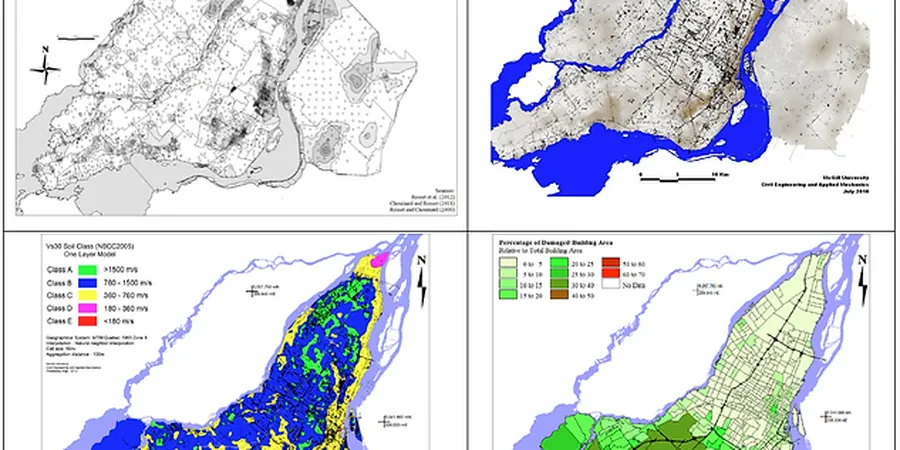
NZS 1170.5 site subsoil classification alone often misses the sharp spatial variations in Christchurch. The 2010-2011 Canterbury sequence proved that two adjacent sections can experience fundamentally different ground motion and damage patterns. A detailed seismic microzonation resolves that. The work combines deep shear-wave velocity profiling, borehole data, and the strong-motion records captured at stations like CBGS and CCCC. The output is not just a site class map — it is a calibrated ground-response model that feeds directly into foundation design. For sites near the Avon River or within the former swamp zones, we integrate CPT testing to capture thin liquefiable layers that standard SPT spacings can miss, and MASW surveys to define Vs profiles down to 30 m and beyond for site period calculation.

Two sites 200 m apart in Christchurch can have a 40% difference in spectral acceleration at 0.5 s — microzonation quantifies that gap.
Our service areas

Methodology and scope

A common mistake after the rebuild was treating microzonation as a desktop exercise — pulling a TC3 classification from the MBIE map and moving on. That map is a regional screening tool, not a site-specific design input. A real microzonation study drills into the shallow stratigraphy. Christchurch's Riccarton Gravel and Christchurch Formation contact can rise or drop several meters across a single section, altering the Vs30 by 150 m/s or more. The field program includes downhole or crosshole seismic in at least one deep boring, paired with surface-wave lines to verify lateral continuity. When a site sits over a paleochannel — common in the eastern suburbs — the ground-motion amplification at 0.5-1.0 s period can be double the code default. The team cross-checks the Vs profile against liquefaction analysis results to confirm that low-velocity zones correlate with contractive silts. The deliverable includes site-specific response spectra and design ground-motion time histories compatible with NZS 1170.5 and the NZGS seismic design guidelines.
Seismic Microzonation in Christchurch: Site-Specific Ground Response
Technical reference — Christchurch

Local considerations

The contrast between Christchurch's western gravel fans and eastern alluvial basins creates two distinct seismic hazard profiles within the same city. A shallow gravel site in Riccarton may amplify short-period motion and trigger little to no liquefaction. A deep fine-grained soil profile in Linwood can amplify long-period energy and exhibit cyclic softening at multiple depths. Ignoring this contrast leads to uniform foundation designs that are unsafe in one location and wasteful in another. The 22 February 2011 event showed exactly this: spectral accelerations in the central city exceeded the 2500-year return period design spectrum at periods critical for mid-rise structures. A microzonation study explicitly maps these site-response differences. It identifies zones where basin-edge effects may amplify ground motion and where soil-structure resonance could affect buildings of a particular height. The result is a defensible basis for site-specific spectra that the structural engineer can use directly, rather than defaulting to the code spectrum.

Need a geotechnical assessment?

Reply within 24h.

Email: contact@geotechnical-engineering1.co

Applicable standards

NZS 1170.5:2004 Structural design actions — Earthquake actions, NZGS Earthquake Geotechnical Engineering Practice Module 5: Site Characterisation, ASTM D4428/D4428M-14 Standard Test Methods for Crosshole Seismic Testing

Technical parameters

ParameterTypical value
Vs30 range in Christchurch soils120 m/s (soft peat) to 550 m/s (Riccarton Gravel)
Site subsoil class per NZS 1170.5:2004Class C, D, or E depending on Vs30 and depth to rock
Fundamental site period range0.2 s to 1.8 s for deep basin sites
Typical number of deep boreholes1-3 with downhole seismic to 30 m
Surface-wave line length46 m to 92 m, often 2-4 parallel lines
Ground-motion input2010 Darfield and 2011 Christchurch records, scaled to ULS/SLS
Reporting standardNZGS Module 5 (site characterisation) compliant

Frequently asked questions

How does Christchurch's seismic microzonation differ from the MBIE TC1/TC2/TC3 maps?

The MBIE technical category maps were developed as a rebuild planning tool after the 2010-2011 earthquakes, based on regional-scale data and observed land damage. A site-specific microzonation study drills deeper — literally. It uses new borehole and CPT data, measured shear-wave velocities, and site-response modeling to produce quantitative design spectra and liquefaction estimates for a single property. The MBIE map tells you what category you are in; a microzonation study tells the structural engineer exactly what ground acceleration and displacement to design for.

What is the typical cost range for a seismic microzonation study in Christchurch?

The cost depends on the number of deep boreholes and surface-wave lines required. For a standard commercial or multi-unit residential site, studies generally range from NZ$6,480 to NZ$29,860. A smaller single-dwelling site with one deep boring and MASW lines may fall at the lower end, while a large development requiring multiple deep profiles and 2D basin-edge analysis will be at the upper end.

Which Christchurch soil formations are most critical for site-response analysis?

The Christchurch Formation — a dense, gravelly sand — and the overlying Riccarton Gravel are key because their depth and thickness control the Vs30 and fundamental site period. The Springston Formation's fine sands and silts, widespread in the eastern suburbs, are critical for liquefaction triggering. Paleochannel deposits beneath the Avon and Heathcote floodplains can introduce thin, highly contractive layers that dominate the site response at specific periods.

Can a microzonation study reduce foundation costs?

The reference range for this service in Christchurch is NZ$6.480 - NZ$29.860. The final price depends on the project scope and volume.

Location and service area

We serve projects across Christchurch and its metropolitan area.

View larger map