GEOTECHNICAL ENGINEERING1
CHRISTCHURCH
HomeIn-Situ TestingField permeability test (Lefranc/Lugeon)

Field Permeability Testing (Lefranc/Lugeon) in Christchurch

Sound ground. Sound decisions.

LEARN MORE

Christchurch's urban fabric, rebuilt with resilience after the 2010–2011 Canterbury earthquake sequence, rests on a complex alluvial puzzle. The shallow gravels, sands, and silts of the Waimakariri River fan dominate the subsurface, yet their permeability varies wildly from one terrace to the next. For any project involving basements, retaining structures, or stormwater infiltration — from the Innovation Precinct to residential zones in Riccarton — relying on textbook values invites costly surprises. A test pit program can visually log these fluvial layers, but it cannot quantify the hydraulic conductivity that governs seepage forces. We run the Lefranc test in saturated soils above the water table and the Lugeon test in fractured rock or weakly cemented gravels, delivering site-specific k-values that feed directly into dewatering design and long-term drainage strategy. Our Christchurch team brings this data together with CPT soundings for a complete stratigraphic and hydraulic profile.

A single Lugeon test in the Riccarton Gravel can reveal tenfold differences in hydraulic conductivity over two meters, making it non-negotiable for accurate dewatering design in Christchurch.
Our service areas

Methodology and scope

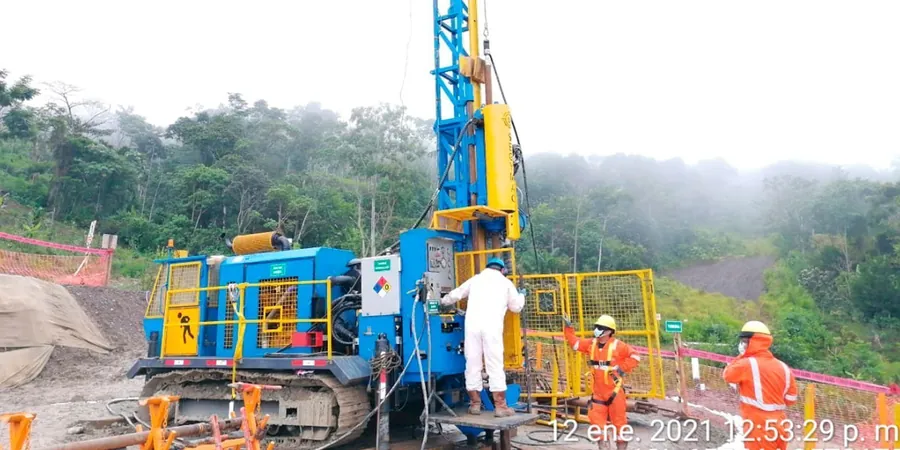
The Canterbury Plains conceal a high groundwater table that, in many Christchurch neighborhoods, sits barely two meters below the surface. Combined with the interbedded lenses of fine sand and open-work gravels left by the Waimakariri's braided history, the hydrogeological setting can change within the footprint of a single building. The Lefranc method — whether constant-head or falling-head — isolates a test section within a borehole to measure permeability in granular soils directly, typically returning values between 1×10⁻⁵ and 1×10⁻³ m/s for the clean gravels found near Burnside. Where the subsurface transitions into the Riccarton Gravel or the underlying volcanic rock, the Lugeon protocol applies: we inject water at stepped pressures, recording the lugeon unit (1 Lu ≈ 1.3×10⁻⁷ m/s) to classify the rock mass's tightness. Pairing these tests with a grain-size analysis helps us validate the field results against Hazen or Kozeny-Carman empirical estimates, ensuring the numbers make physical sense before they enter a MODFLOW or SEEP/W model. For deep excavations in the CBD, the data also supports excavation monitoring plans by predicting inflow rates and required well-point spacing.
Field Permeability Testing (Lefranc/Lugeon) in Christchurch
Technical reference — Christchurch

Local considerations

Canterbury's seasonal shifts — dry northwesters in summer giving way to sustained winter rains — cause the water table to fluctuate by over a meter in some suburbs. A permeability test run in February can give a deceptively low equilibrium level if the following July's groundwater rise re-activates paleochannels not seen in the bore log. Christchurch's post-quake liquefaction research also showed that the same clean sands that drain well under static conditions can develop excess pore pressure during seismic shaking; a Lefranc k-value alone does not predict this cyclic response. We therefore advocate coupling the permeability dataset with liquefaction assessment when the project lies within the Technical Category 3 zones or close to the Avon River corridor. Overlooking seasonal and seismic factors leads to undersized sump pumps, failed soakage systems, and, in the worst case, buoyancy-driven uplift of empty tanks during a high-rainfall winter. Our reports always state the measurement date, the standing water level at time of test, and the recommended seasonal correction factor for permanent works.

Need a geotechnical assessment?

Reply within 24h.

Email: contact@geotechnical-engineering1.co

Applicable standards

NZS 4203: General structural design and design loadings (relevant for groundwater loads), NZGS Guideline for Field Description of Soil and Rock, ASTM D4630: Standard Test Method for Determining Transmissivity and Storage Coefficient of Low-Permeability Rocks

Technical parameters

ParameterTypical value
Test methodsLefranc (constant/falling head) in soil; Lugeon (packer) in rock/gravel
Standard referenceASTM D4630, NZGS Field Description of Soil and Rock
Soil k-range (clean gravels)1×10⁻⁵ to 1×10⁻³ m/s (Christchurch typical)
Rock mass classification1–5 Lu (tight) to >100 Lu (very permeable)
Borehole diameterHQ to PQ, depending on target depth and lithology
Test pressure steps5–7 steps for Lugeon, following Houlsby criteria
Reporting outputk-value per test interval, packer location log, pressure-flow plots

Frequently asked questions

When should a Lugeon test be specified instead of a Lefranc test in Christchurch?

The decision depends on lithology, not depth alone. The Lefranc test works in granular soils — sands, silts, and gravels — where the borehole wall can stand open. Once you encounter the Riccarton Gravel (a dense, weakly cemented conglomerate) or the volcanic rock beneath it, the formation behaves more like a fractured rock mass. That's where the Lugeon test with packers becomes necessary to isolate test intervals and apply controlled pressure steps. In practice, many Christchurch projects start with Lefranc in the upper alluvium and switch to Lugeon if rock is encountered above the planned foundation depth.

What does a field permeability test cost for a typical Christchurch residential or commercial site?

A single Lefranc test within a standard borehole typically runs between NZ$1,000 and NZ$1,500, depending on access and depth. A full Lugeon profile with five pressure steps in rock usually falls between NZ$1,500 and NZ$1,940 per test interval. The total program cost depends on the number of test zones required to characterize the site; we can provide a fixed-price quote once we review the preliminary geotechnical desk study.

How long does a Lefranc or Lugeon test take to complete on site?

A single Lefranc constant-head test typically requires 60 to 90 minutes once the test zone is prepared, including the time to achieve a stable flow reading. A Lugeon test takes longer — approximately two to three hours per interval — because we run multiple pressure steps and allow flow to stabilize at each step. We usually schedule permeability testing alongside other fieldwork such as SPT sampling or CPT soundings so the drill rig is used efficiently throughout the day.

Location and service area

We serve projects across Christchurch and its metropolitan area.

View larger map